Over the past year, I’ve been building and refining a structured PMO environment using Microsoft Project, Dataverse, and Power BI.
This hasn’t been theoretical work. It’s been hands-on — designing how projects are structured, how data flows, and how reporting reflects real delivery conditions.
Because of that, I tend to look at Microsoft announcements a bit differently.
Not in terms of features —
but in terms of how they change how work actually gets done.
🔍 What E7 Actually Signals (Not a Feature List)
With the introduction of Microsoft E7, most of the conversation will focus on what’s included:
– E5
– Copilot
– Agent governance
– Security and identity layers
That’s useful context — but it’s not the interesting part.
What’s more important is what this represents structurally:
Microsoft is beginning to define a default operating layer for enterprise environments that includes AI as a first-class participant.
🧠 From Assistive AI → Operational AI
One of the most notable shifts is how Copilot is evolving.
We’re moving from:
– AI that helps draft content
– AI that answers prompts
👉 toward:
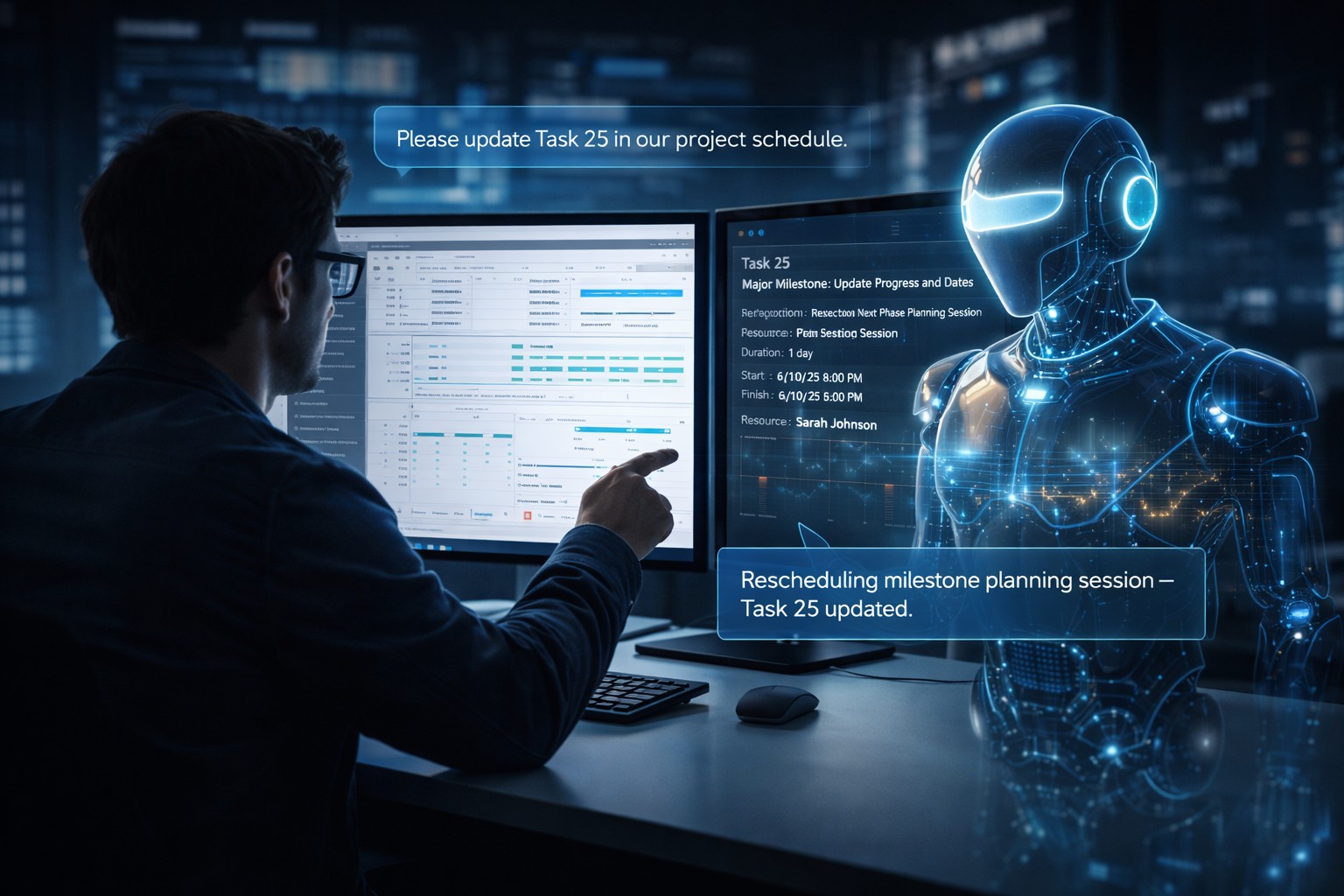
– AI that can participate in workflows
– AI that can operate inside systems
In a PMO environment, that’s a meaningful shift.
Because these aren’t unstructured spaces.
They’re built around:
– dependencies
– sequencing
– constraints
– reporting logic
As someone who has always viewed scheduling as a deeply manual discipline — something developed through experience and structured thinking —
— this raises an interesting question:
What happens when interaction with that system becomes conversational… or even partially autonomous?
Not replacing the discipline —
but changing how we engage with it.
⚙️ The Quiet but Bigger Shift — Agent Governance
The introduction of Agent 365 may end up being the more important development.
For a long time, governance has meant:
– managing users
– controlling access
– structuring workflows
Now, we’re entering a space where governance includes:
managing AI agents operating inside the system
That’s a different model entirely.
It introduces questions around:
– visibility
– control boundaries
– auditability
– decision tracing
This is not a tooling shift — it’s a shift in how work is performed inside systems.
From a delivery perspective, this is where things become very real.
🏗️ Licensing Is Becoming Architecture
E7 is not just bundling tools.
It’s packaging an assumed architecture.
Instead of:
– selecting individual components
– designing integrations
We’re seeing:
a predefined stack that organizations are expected to build on top of
That has implications for:
– how environments are designed
– how quickly systems can be deployed
– how governance is implemented
🔭 Where This Becomes Personal (MYT Perspective)
For me, this isn’t abstract.
I’m already operating inside a version of this environment:
– Project for structured scheduling
– Dataverse as a backbone
– Power BI for reporting
– CoE principles for governance
So when I look at E7, I don’t see a new license.
I see a shift that will directly affect:
– how I build
– how I test
– and how I deliver
📅 What Happens Next (The Real Value)
E7 becomes available May 1st.
At that point, the real work begins.
Not analysis.
Not speculation.
👉 Interaction.
My goal is simple:
to work inside this environment, observe what actually changes, and document it honestly.
What works.
What doesn’t.
What feels transformative — and what doesn’t.
🧭 Closing
We’re still early.
But the direction is becoming clear:
Enterprise environments are evolving from systems we use…
to systems that increasingly participate alongside us.
That’s a meaningful shift.
I’ll revisit this once E7 is in hand and share what actually changes in practice.