Beyond Silicon
For more than half a century, silicon has been the bedrock of modern technology. It is the quiet enabler behind smartphones, cloud computing, electric cars, and the Internet itself. But like any material, silicon has limits. As chips shrink to nanometer scales and demand for power efficiency skyrockets, researchers worldwide are asking a provocative question: what comes after silicon?
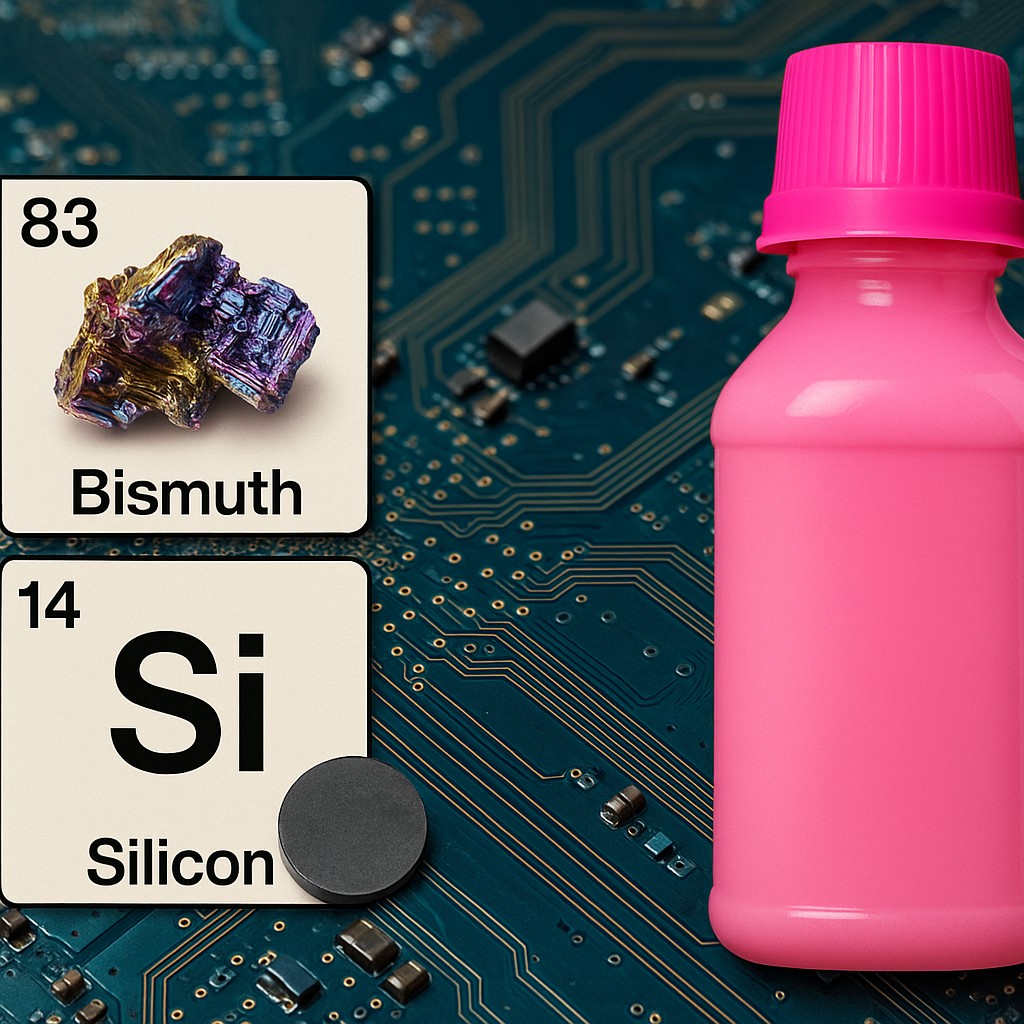
This summer, a research team at Peking University offered one possible answer. They unveiled a gate-all-around field-effect transistor (GAAFET) built not on silicon, but on a two-dimensional material called bismuth oxyselenide (Bi₂O₂Se). Yes, that’s the same element — bismuth — that also happens to be the active ingredient in Pepto-Bismol.
Their results? Reported performance up to 40% faster and 10% more energy-efficient than the world’s leading 3-nanometer silicon transistors.
It’s a laboratory breakthrough, not a commercial chip — but it’s also a flash-point. Bismuth may never fully dethrone silicon, yet its very emergence as a credible contender signals that we’ve crossed into a new chapter: the post-silicon era.
What Is a Semiconductor, Really?
To understand why this matters, let’s rewind to the basics.
At the most fundamental level, materials fall into three categories:
- Conductors (like copper) let electrons flow freely.
- Insulators (like glass or rubber) block electrons completely.
- Semiconductors sit in between, able to conduct electricity under certain conditions and block it under others.
This “switchability” makes semiconductors the foundation of transistors — tiny switches that can turn current on or off. Billions of these transistors sit on each microchip, enabling everything from simple calculators to AI supercomputers.
Why did silicon dominate? Three reasons:
- Abundance – Silicon is the second-most abundant element in the Earth’s crust.
- Stability – It naturally forms a stable oxide layer (SiO₂), critical for building reliable transistors.
- Manufacturability – Decades of refining silicon processes have created a trillion-dollar ecosystem of fabs, tooling, and know-how.
But as engineers push below 5nm — with transistor gates only a few dozen atoms wide — silicon is running into physics itself. Leakage currents, heat buildup, and quantum effects make it harder to shrink further without massive tradeoffs. That’s why the hunt is on for alternative materials.
The Breakthrough at Peking University
Enter bismuth oxyselenide (Bi₂O₂Se).
The Peking University team fabricated a GAAFET — a next-generation transistor architecture where the “gate” (the control electrode) completely surrounds the channel. This design provides far better electrostatic control, reducing leakage and improving energy efficiency compared to traditional FinFETs.
Instead of silicon, they used a sheet of Bi₂O₂Se only a few atoms thick as the transistor’s channel. Their results:
- Performance: ~40% faster operation compared to state-of-the-art 3nm silicon benchmarks.
- Efficiency: ~10% lower power consumption.
- Scalability: The 2D nature of Bi₂O₂Se makes it easier to keep shrinking transistors without leakage spiraling out of control.
On paper, this is remarkable. For decades, most “post-silicon” claims have been either incremental or stuck in theory. This research shows a working device with real, measurable gains.
Why Bismuth?
Bismuth might seem like an odd candidate — most people know it, if at all, from Pepto-Bismol. Yet in the world of materials science, bismuth compounds have some unique properties:
- High electron mobility: Electrons can move faster through Bi₂O₂Se than silicon, meaning quicker switching speeds.
- 2D thinness: Bi₂O₂Se can form stable sheets just a few atoms thick, ideal for ultra-small transistors.
- Low leakage: The material suppresses current “leakage” at nanoscale dimensions, which is one of silicon’s biggest problems below 5nm.
- Compatibility with existing processes: While not a drop-in replacement, Bi₂O₂Se has fewer integration challenges than exotic materials like pure graphene.
In other words, bismuth isn’t just a novelty — it actually solves some of the scaling headaches silicon faces.
The Challenges Ahead
Of course, one lab result does not overturn 50 years of industry momentum. For bismuth to matter at scale, it must clear some very real hurdles:
- Interface Defects – Tiny imperfections where Bi₂O₂Se meets other materials can degrade performance.
- Thermal Management – Chips generate heat; how Bi₂O₂Se handles sustained thermal loads is still under study.
- Manufacturing Integration – Today’s fabs are built for silicon. Retooling them for bismuth-based processes would be expensive and slow.
- Yield and Cost – Producing millions of identical nanoscale devices without defects is notoriously hard.
These aren’t deal-breakers, but they’re why even the most optimistic researchers frame timelines in decades, not months.
Strategic Significance: The Post-Silicon Race
The technical story is only half the picture. The geopolitical context makes this breakthrough especially charged.
- China’s push for independence: Facing restrictions on advanced chip imports, China is investing heavily in alternative semiconductor pathways. A credible bismuth transistor is both a scientific milestone and a strategic signal.
- Global post-silicon research: Other contenders include graphene, molybdenum disulfide (MoS₂), germanium, and even carbon nanotubes. Each has unique strengths — and unique integration challenges.
- The flash-point idea: Even if Bi₂O₂Se never reaches mass production, the fact that a working GAAFET with superior metrics has been demonstrated in China could influence funding, partnerships, and policy far beyond the lab.
In short, the “post-silicon race” isn’t just about science — it’s about technological sovereignty, supply chain resilience, and long-term power in the digital economy.
The Road to Market
What’s realistic to expect from here?
- Short term (1–3 years): Continued academic papers, small prototypes, and proof-of-concept devices.
- Medium term (3–7 years): Potential integration in niche markets like low-power sensors, flexible electronics, or specialized accelerators.
- Long term (7–15 years): If challenges are solved, Bi₂O₂Se or similar 2D materials could appear in mainstream chips, possibly alongside silicon in hybrid designs.
The key takeaway: this is not an overnight disruption. But it is an inflection point — the first sign that silicon’s crown might not be eternal.
What This Means for Business & Technology Leaders
For CIOs, IT leaders, and policymakers, the practical question is: so what?
Here are three signals worth watching:
- Patents & IP filings – If bismuth-related patents spike, it’s a sign that companies see commercial potential.
- Pilot fabs – Any announcement of production lines experimenting with Bi₂O₂Se would be a watershed moment.
- Consortia & partnerships – Look for global alliances (academia + industry) that treat bismuth as a serious candidate, not just a curiosity.
For MSPs, PMOs, and enterprise planners, the message is subtler but important: the materials underlying IT are entering a period of experimentation not seen since the 1950s. That means more volatility, more headlines, and more strategic decisions where leaders need trusted interpreters.
Closing Reflection
Silicon will not disappear overnight. Its ecosystem is too entrenched, its advantages too mature. But the age when “silicon is forever” is now over.
Bismuth oxyselenide may or may not be the successor. Yet its very emergence — a working device that beats silicon benchmarks — marks a flash-point in how we think about the future of computing.
At Manage Your Tech, Ltd., we don’t just watch breakthroughs like this from the sidelines. We interpret them, connect them to the realities of business and governance, and help clients navigate the shifting ground beneath our digital infrastructure.
The next decade of innovation won’t be defined by silicon alone. It will be shaped by whatever materials — and whatever nations — seize the post-silicon opportunity.
And today, bismuth just put its name on that list.